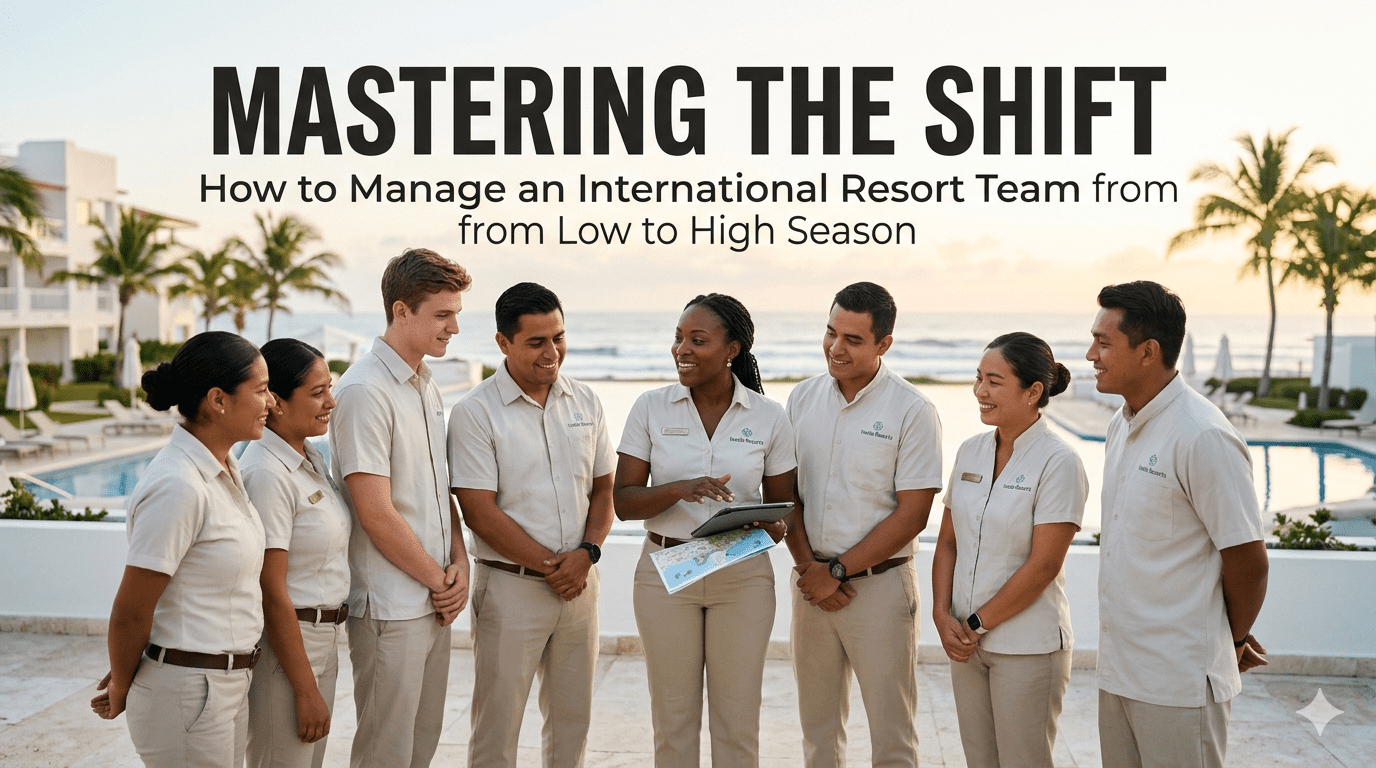

Managing an international team is easily one of the most rewarding yet challenging roles in the resort industry. The sheer amount of experience you gain by working alongside different cultures and nationalities is immense. However, bridging those cultural gaps while preparing for a grueling high season comes with its own unique set of hurdles.
If you want to lead your team effectively without burning out, you need a strategy that evolves as the season progresses. By focusing on three core pillars—Language, Attention, and Structure—you can navigate cultural differences, build fierce loyalty, and get the absolute best out of your team.
Here is your playbook for turning a diverse group of individuals into a high-performing, synchronized unit.
1. Language: Moving Beyond the Basics to Human Connection
Getting everyone’s attention and steering them in the right direction requires common ground. Establishing a shared operational language is the absolute foundation of an international team. However, just because everyone speaks the same language doesn’t mean your point is actually getting across.
True leadership lies in the human connection. Different cultures and nationalities have vastly different ways of expressing themselves, reading body language, and interpreting tone. For example:
- Humor and Directness: A joke that sounds lighthearted to a Western European colleague might feel unprofessional or even offensive to a team member from East Asia or Eastern Europe.
- Feedback Styles: Some cultures appreciate blunt, direct feedback, while others require a softer, more diplomatic approach to save face.
The Fix: In the beginning, you must over-communicate with absolute clarity. Be incredibly articulate, minimize slang, and never assume a nod means full understanding. Speak clearly, invite questions, and actively study how your team members prefer to communicate.
2. Attention: The Power of Group Dynamics vs. One-on-Ones
To truly understand your team’s dynamic and navigate national differences, you have to split your focus into two equally important buckets: Group Attention and Individual Attention.
- Group Attention allows you to see how they function as a single unit. Who steps up? How do different nationalities naturally form sub-groups, and how can you blend them?
- One-on-One Attention is where the real magic happens. This is your chance to understand the individual behind the employee—their personal goals, their anxieties about the upcoming season, and their cultural background.
Think of yourself as the glue. By dedicating time and energy to both the collective team and the individual, you connect these two worlds together. This deep understanding is exactly what prevents misunderstandings and friction later on.
3. Structure: The 4-Phase Seasonal Framework
All the bonding in the world won’t save you if you don’t have a reliable operational system. In the resort industry, your leadership style must adapt to the seasonal rhythm.
Here is the exact framework that yields excellent results, shifting your role from hands-on teacher to high-level strategist:
Phase 1: Show, Don’t Just Tell (Low Season)
In the beginning, talk is cheap. To build authentic authority with an international team, you need to physically show them that you can do the job. Do the heavy lifting alongside them. When a diverse team sees that their manager isn’t afraid to get their hands dirty, it instantly breaks down cultural barriers and builds trust in your judgment.
Phase 2: Foster Partnership & Friendships (Low Season)
Once the baseline is set, involve your team physically and work tightly together. This fosters a powerful feeling of partnership; you stop being just “the boss” and become colleagues. Use this low-season period to ramp up your one-on-one time and form genuine friendships.
Phase 3: Step Back and Guide (Early June)
As the calendar hits early June, the shift begins. Now, they do the work, and you watch and guide. This is the critical buffer period right before the high season hits. Use this time to let the team prove to you—and to themselves—that they are capable of handling the workload.
Phase 4: Autonomous Performance (High Season Onward)
When the peak high season arrives, your team should function correctly even when you aren’t in the room. Because you built the foundation in the low season, everyone knows their job. This finally frees up your time to step away from daily fires, focus on the fine details, and elevate your department to excellent levels of performance.
Troubleshooting Your Timeline
If you find yourself in the middle of June or July and your team is chaotic, screaming at one another, or failing to meet standards, stop and evaluate.
You cannot force a team into Phase 4 if you skipped Phase 1 or 2. If you are out of alignment with your seasonal timeline, take the time to go back, figure out what you missed—whether it was a breakdown in clear communication or a lack of individual trust—and fix it before the peak season overwhelms you.
Managing an international team isn’t about erasing cultural differences; it’s about building a structure that respects those differences while uniting everyone under a shared goal. Put in the work during the low season, and your team will carry you through the high season.
📖 Take Your Entertainment Management to the Next Level
If you found this tactical breakdown useful, you will find the complete seasonal blueprint in The Soul of the Resort: A Management Guide to Hotel Animation.
Written for industry veterans and forward-thinking hotel directors, this paperback covers everything from cross-cultural team recruitment and schedule optimization to managing stakeholder expectations.